I am a tech explorer driven by curiosity and creativity. My journey began with solar energy and evolved into a deeper understanding of how technology empowers people and reshapes lives.Each line of code—like every ray of sunlight—holds the potential to illuminate, connect, and transform our world.
Screens are part of modern life — from laptops at work to phones at night. While tools like blue-light glasses can help, the truth is that lasting digital wellness comes from a set of simple habits anyone can build.
1. Follow the 20-20-20 Rule 👀
Every 20 minutes, look at something 20 feet away for at least 20 seconds. It gives your eyes the micro-breaks they need.
A quick stretch break every hour helps your eyes and body reset.
Most devices have a “Night Shift” or “Blue Light Filter.” Turning it on in the evening helps reduce glare and prepare your body for sleep.
3. Take Micro Breaks 🧘
Stand, stretch, or walk for a minute every hour. Movement lowers stress and helps your eyes reset.
4. Manage Notifications 🔕
Constant pings increase screen fatigue. Turn off non-essential alerts or use focus mode to stay balanced.
Conclusion
Digital wellness isn’t about avoiding screens — it’s about using them smarter. Combine these habits with tools like blue-light blocking glasses to reduce strain, improve sleep, and live healthier in a digital-first world.
👉 Explore more in my full post: Blue-Light Glasses — Do They Really Work?
In Nigeria—home to one of the world’s most entrepreneurial populations—side hustles are more than just extra income. They’ve become a hallmark of ambition and resilience. Whether you want to supplement your salary, gain financial independence, or even launch a future full-time business, there are multiple high-impact hustles you can start today with minimal capital—no MBA required!
👉 Looking for online income streams? Check out our guide on apps Nigerians should be using for daily life
1. Digital Content Creation
Best for: Creatives, teachers, and anyone with a smartphone.
YouTube & TikTok: Share cooking recipes, comedy skits, skill tutorials, or motivational talks. Monetise via ads, sponsorships, and affiliate links.
Blogging & Micro-blogging: Write about tech reviews, Nigerian travel spots, or lifestyle tips. Earn through display ads, sponsored posts, and consulting.
Podcasting: Host discussions on Nollywood gossip, personal finance, or mental health. Once you build a loyal audience, sell sponsorship slots.
💡 Startup cost: Smartphone, decent internet connection, free editing apps. Many Nigerians who gained celebrity status today started took advantage of the internet. Eg. Mark Angel comedy, “Investor Sabinus” etc are just but a few. You can do the same and chat your own course.
Digital content creation is a growing opportunity in Nigeria, requiring minimal tools such as a smartphone and ring light.
👉 For more information, please check out our resource page.
2. E-Commerce and Dropshipping
Best for: Entrepreneurs with an eye for products and branding.
Local handcrafts: Sell beaded jewelry, Ankara fabrics, or shea-butter skincare on Jumia or Konga.
Dropshipping gadgets: Partner with suppliers on AliExpress or Alibaba; products ship directly to your customers.
Print-on-Demand: Use Shopify or Teespring to sell T-shirts, mugs, and tote bags with Naija slogans worldwide.
💡 Pro tip: Customer service is everything—fast responses, shipping updates, and easy returns build trust.
Product showcase of handmade jewellery and a Naija T-shirt design.
✔ Validate demand: Ask friends, family, or online groups. ✔ Set goals: Define your budget, time, and revenue targets. ✔ Build your brand: Pick a name, create social media pages, and post consistently. ✔ Deliver excellence: Reliability and quality create repeat customers. ✔ Reinvest profits: Use earnings for marketing, equipment, or stock growth.
Conclusion
Side hustles in Nigeria are more than just extra cash opportunities—they’re incubators for skills, networks, and confidence. By leveraging your talents and Nigeria’s vibrant market, you can transform a simple idea into a thriving venture.
Start small, stay consistent, and grow your side hustle into something much bigger.👉 Looking for more? Read our post on How to Use Apps to Earn Extra Income in Nigeria
Trading has always seemed like something only professionals do — the type of thing you see in movies with lots of flashing screens and complex charts. But when I decided to explore the world of trading for myself, I quickly realised: you don’t have to be a professional to start — you just have to be willing to learn, step by step.
A recent conversation with a childhood friend, Moses, gave me new ideas. Later, I spoke again with another very good childhood friend of mine, (Mr Pee) Pius Anokwu, who has been involved in trading for some time. Whenever time permits, we talk — among other things — about trading. There were also a few colleagues at work who engaged in meaningful conversations about trading and were always willing to explain a few concepts when I asked.
Other happenings — my tech journey, random Facebook and Instagram ads — kept nudging me toward it. And the idea that I could enhance my IT learning by building an automated trading dashboard really set me on the path.
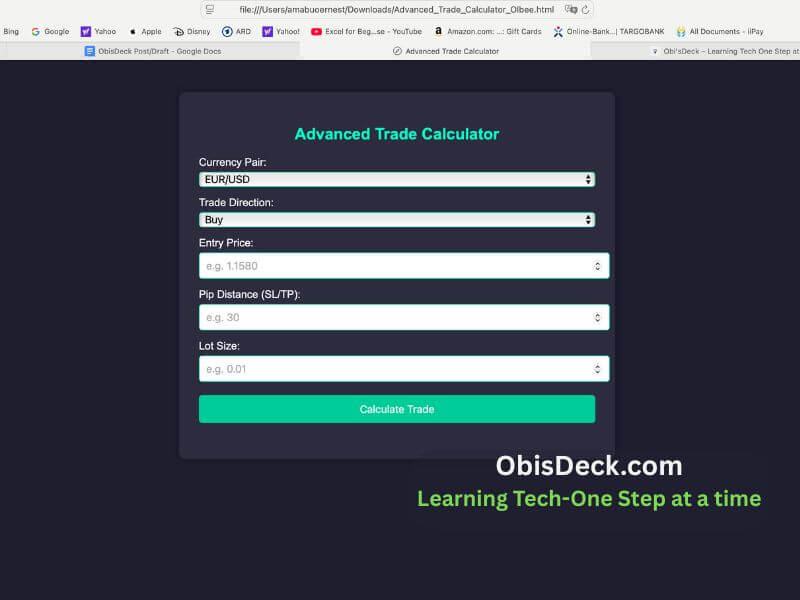
So, over the past few weeks, I’ve been diving into trading using MetaTrader 5 and setting up a proper trading journal. I also began building simple tools — like a pip calculator — and practicing with a demo account through Admiral Markets.
Why I Decided to Learn Trading
Information about trading has always been around me. I’m not talking about the get-rich-quick ads on Facebook or Instagram that push you toward buying strategies or courses. I’m talking about real trading insights: strategies, deeper understanding, the risks and the potential gains.
Conversations with a few people, as I mentioned, helped set me on this path. But the final spark was the possibility of taking structured steps and learning by building pip calculators, trading journals, and tools — all leaning toward automation, which is part of my broader IT learning journey.
This is also part of my pursuit of new ways to generate income. I wanted something that: ✅ Is flexible (I can trade even with a full-time job) ✅ Can be scaled over time ✅ Gives me full control — no one manages my money but me
Trading matched these goals — but I knew it also came with risks. That’s why I committed to learning first, not rushing.
Lessons From My First Trading Weeks
A Trading Journal Is Essential
Keeping records of each trade (what I saw, why I entered, what happened) helps me learn much faster than just guessing or jumping in blind.
I used to think trading involved everything but skill. Now I know that “luck is the intersection between preparation and opportunity.” You must learn the “waltz and foxtrot” of it all. Commit to a deeper learning of the process and extricate yourself from emotions that come with it while focusing on technical and fundamentals of the entire exercise.
Understanding Risk-Reward
Using a clear R:R (Risk-to-Reward) ratio for every trade helps me protect my account and avoid emotional trading.
Building Tools Helps Learning
Creating my own pip calculator in JavaScript has taught me more about pip size, SL/TP, and pair differences than any YouTube video could.
While I don’t underestimate the importance of good YouTube videos on trading, one should be able to localize what is learned — by taking from them and building tools that work for you.
What I’m Working On Next
✅ Testing small demo trades using my tools ✅ Learning more about using technical indicators (RSI, Moving Averages) ✅ Improving my Google Sheet trading dashboard ✅ Exploring automation possibilities (APIs, Zapier) ✅ Continuing to journal every step — wins and mistakes
Final Thoughts: Trading Is a Journey, Not a Race
If you’re new to trading like me, here’s my advice:
Don’t try to “beat the market” overnight. Start with learning, take notes, build your tools, and track your progress.
This is exactly what I’m doing — and I will continue to share both my wins and mistakes as I go.
Stay tuned for more — and if you’re on a similar learning path, let’s connect!