The Moment CSS Made Me Feel Confident

HTML helped me understand structure-the sequence that follows the words as we see them on our web pages.

CSS did something else.

It gave me confidence- The power to affect the styles and colours of those words: the building blocks, that appear on the web.

Not the loud kind of confidence. Not the kind that announces itself.
The quiet kind — the kind that settles in slowly and stays.


At first, Cascading Style Sheet, CSS felt like decoration.

Colors.
Spacing.
Fonts.
Layout tweaks.

It didn’t seem essential in the way HTML did. HTML explained what things were- essentially the building blocks. CSS only changed how they looked — or so I thought.

But the first time I changed a color and saw the page respond, something shifted.


Then it happened again.

I adjusted spacing and the layout stopped feeling cramped.
I styled a button and it finally looked clickable and appeared in clean colours that could be tweaked by mere adjustment of a few codes.
I fixed a broken alignment and understood why it had been wrong in the first place.

None of these moments were dramatic.
But together, they changed how I felt about what I was building.

For the first time, I wasn’t just placing content on a page.

I was shaping it.


CSS didn’t make me feel like an expert.

It made me feel in control — even if only a little.

That mattered more than I expected.

Before then, tech often felt fragile. One small change could break everything. the small frustration that creeps in when it does. I wasn’t always sure why something looked wrong, only that it did.

CSS slowed that chaos down. It meant that for every break, there is a reason. Once the reason is discovered and fixed, everything became normal again.

It taught me that layout follows rules.
That spacing isn’t random.
That visual structure has logic behind it.

Once I understood that, things stopped breaking “mysteriously.”

They broke for reasons. That clarity removed frustrations. If something breaks, find the cause and fix it. That awareness replaced frustrations with patience.


So CSS also taught me patience.

Sometimes a single property didn’t work the way I expected. Sometimes fixing one thing exposed another problem. Sometimes the solution wasn’t obvious.

But each adjustment taught me something.

I began to recognize patterns:

  • why elements stack the way they do,
  • why margins behave differently from padding,
  • why a small change can have a big visual effect…
  • And the beauty of all them put together.

The page stopped feeling hostile.

It started feeling negotiable.


What CSS really gave me wasn’t that beauty.

It gave me incremental control. A feeling of ability that was not as concrete as it became.

I didn’t need to know everything to improve something.
I just needed to understand the next small step.

That realization changed how I approached learning.

Learning tech wasn’t about mastery.
It was about steady influence over the system in front of me. A little consistent steps that beats intensity.


That confidence carried me forward.

Not because the next phase was easier — it wasn’t.
But because I had learned something important by then:

I could move from confusion to clarity, one adjustment at a time.

And once you experience that even once, you trust that it can happen again.


This post is part of my ongoing learning archive.
My Tech Learning Journey — One Step at a Time

Why I Started My Tech Journey with HTML

When I decided to learn tech, I didn’t start with Python or JavaScript.

I started with HTML.

Before then I had become very interested in how images, colours and texts take shape on the web. The forms they take from the time of request till when it appears on our screens. What is responsible for these dynamics? Why do some texts appear in italics, bold or normal? What is responsible for the difference in colours? How is the spacing between words achieved? Why do some texts appear on the right and others on the left? How is this achieved? How do I get to have options and when I make inputs, I get results? It was these interests that churned on as the days passed that led me to the building block of the web-HTML.

At the time, it didn’t feel like a bold decision especially when I discovered a few days into the study what Ai could now do in that respect. Even a friend of my in the Tech industry whom I had informed of my interest and my decision to learn this skill alluded to this fact. He said it was a waste of time and advised that I focus on other more profitable aspect of Tech. But that did not assuage the thirst and I kept on. And Thank God I did!

But it felt almost underwhelming. I did not understand why. HTML wasn’t glamorous. It didn’t promise automation, intelligence, or complex logic. It was just structure — tags, elements, and files.

And at first, it felt too simple.
Almost boring.

But looking back now, that simplicity was exactly what I needed. It provided the type of ground that formed my very first steps in this journey. The exact type I so much desired.


HTML was the first time tech stopped feeling abstract.

Before then, “the web” was something I used, not something I understood. Pages loaded. Buttons worked. Content appeared. But none of it had a shape in my mind only bewilderment that later gave rise to interest.

HTML changed that.

It showed me that the web isn’t magic — it’s structure.
Headings, paragraphs, links, images.
Files connecting to files.
Content arranged intentionally.

For the first time, I could see how things fit together.


What HTML gave me wasn’t intelligence.
It gave me orientation. A picture; an outline.

I began to understand:

  • how content is displayed,
  • how a browser reads files,
  • how one file can point to another,
  • how a simple mistake can break a page — and how fixing it restores order.

These weren’t advanced concepts, but they were grounding.

Instead of feeling lost inside “tech,” I had a map.


More importantly, HTML gave me early wins. I now saw how websites are built. How the texts are formed. How images are rendered.

I typed something.
I saved the file.
I opened it in a browser.

And there it was.

It didn’t matter that it looked ugly.
It didn’t matter that it wasn’t styled.
What mattered was that something I created appeared in front of me.

That moment did more for my confidence than any explanation ever could. And it was fun too to see the “magic” I could now activate!!


HTML didn’t make me feel “smart.”

It made me feel capable.

That difference is subtle, but important.

Feeling smart fades quickly when things get hard.
Feeling capable stays with you when you hit confusion.

I had been somewhat carefree in handling files. HTML taught me that I could:

  • follow structure,
  • make sense of errors,
  • fix what was broken,
  • and build something visible from nothing.

At the beginning, that matters more than complexity.


Looking back now, I see that starting with HTML wasn’t about learning a language.

It was about learning how to stand inside tech without fear.

It slowed things down in the right way.
It removed pressure.
It allowed understanding to form without intimidation.

Though I am still learning but that foundation made everything that followed possible.


If you’re starting tech today, HTML is not a waste of time.

It won’t impress anyone just like I did not impress my friend.
It won’t make you feel advanced.

But it will give you something more valuable early on:

A sense that you belong here.
A sense that you can build.
A sense that learning is possible.

And sometimes, that’s the most important foundation of all.


This post is part of my ongoing learning archive.
My Tech Learning Journey — One Step at a Time

Why I am Documenting My Tech Learning Properly This Time

I have been learning tech for a while now. 

HTML.
CSS.
JavaScript.
Python.

On paper, it looks like progress. And in many ways, it was.

But recently, I realized something important:

I learned, what I should consider, a lot of things, yet I didn’t truly document the journey.

Not the confusion.
Not the incessant nudge to give up.

Not the false starts.
Not the moments when things didn’t make sense but I kept going anyway.

What existed were outcomes — not the thinking that led to them.


For a long time, I assumed documentation was something you did after you had figured things out. Something reserved for experts, teachers, or people who already had clarity.

So I focused on consuming content instead:

  • tutorials,
  • guides,
  • videos,
  • explanations.

I was learning, yes — but quietly. Internally. Without leaving a trace of how my understanding was forming.

Looking back now, I see that this made it harder to notice patterns:

  • where I was improving,
  • where I was stuck,
  • what actually helped me move forward.

This time,  I am doing it differently.

Not because I suddenly became more disciplined.
Not because I want to teach.
And certainly not because I think I have “arrived.”

I am documenting because clarity doesn’t come from speed.
It comes from structure.

Writing forces me to slow down.
To name confusion instead of rushing past it.
To understand why something works, not just that it does.


This space — ObisDeck — is not a tutorial platform in the traditional sense.

It is:

  • a learning archive,
  • a thinking log,
  • a place where progress is allowed to be slow,
  • and where understanding is allowed to form honestly.

Some entries will be reflective.
Some will be practical.
Some will simply capture a shift in how I see things.

All of them will be real.


I am not documenting to prove anything.

I am documenting because I have learned that when learning remains invisible, it’s easy to feel like nothing is happening — even when growth is taking place.

By writing things down, I give my learning a shape.
By structuring it, I give it direction.

That’s what this journey is about.


If you’re learning tech quietly —
if you’ve started, stopped, restarted, or hesitated —
or if you’ve felt like you’re “doing the work” but still unsure where you stand,

you’re welcome to follow along.

This is not a race.
It’s a process.

And this is the first step.


This post is part of my ongoing learning archive.
My Tech Learning Journey — One Step at a Time

Why Tutorials Alone Didn’t Give Me Flow

There was a period in my learning where everything looked right from the outside.

I was watching tutorials- Youtube videos and others.
I was reading guides-including PDF´s of code journals, W3Schools website and the in-depth coverage it gave in almost all programming languages.
I was following along, typing what I saw, and getting the expected results.

By most standards, I was “learning.”

But internally, something felt off. And so I felt.

I wasn’t lost, yet I wasn’t settled either. I could reproduce steps, but once the tutorial ended, the confidence faded quickly. The sense of flow I expected never really arrived. I could not actually connect the dots thereafter.

At that stage, my learning was mostly driven by consumption. Wait longer, it tends to dissipate-lost almost completely. And with a bit of frustration at how I could forget so soon, I would go back to try to fill the gaps again.

I moved from one tutorial to the next, assuming that consistency alone would eventually turn into understanding. Each video felt productive. Each article felt useful. And in isolation, they were.

But what I didn’t realize at the time was that I was collecting information, not owning it.

I could follow instructions, but I struggled to explain why something worked. If a small detail changed, I had to go back to the tutorial. If I faced a slightly different problem, the clarity disappeared.

The knowledge was there — but it wasn’t anchored.

This wasn’t a failure of tutorials.

In fact, tutorials helped me overcome fear. They introduced me to tools, concepts, and possibilities I might not have approached on my own. They lowered the barrier to entry and made learning feel accessible.

But they had a limitation I didn’t see early enough.

Tutorials are designed to show a path, not to build ownership. They guide you forward, but they don’t pause to ask whether you truly understand what just happened.

And I wasn’t pausing either. Just going.

The real issue wasn’t that I was learning the “wrong” way.
It was that I hadn’t yet learned how I needed to learn.

I mistook movement for progress.
I assumed that more effort will bring clarity and that staying busy meant things were sinking in.

But flow doesn’t come from repetition alone. It comes from clarity — and clarity only appears when you slow down enough to reflect.

That realization didn’t arrive as frustration or burnout. It came quietly.

I noticed that the moments where things finally made sense were the moments when I stepped away from the tutorial and tried to explain the idea to myself — sometimes in writing, sometimes mentally, sometimes by rebuilding something without guidance.

Those moments were slower. Less impressive. Less visible.

But they stayed with me.

That was the beginning of a shift.

I didn’t abandon tutorials. I simply stopped letting them lead the entire process. I began paying attention to what confused me, where I hesitated, and what I couldn’t explain clearly.

Writing became a tool, not for teaching others, but for understanding myself.

Documenting what I was learning forced me to confront gaps that tutorials had quietly allowed me to skip. Reflection turned passive knowledge into something more solid. Then the dots started connecting.

That’s when learning started to feel different.

This post sits between From Fear to Flow and the more structured journey that followed.

It represents the phase where learning looked productive, but understanding was still forming. It explains why documentation became necessary — not for content, not for performance, but for clarity.

The stages that come after this are shaped by that realization.

I didn’t need more speed.
I needed more structure.

And that’s where the next part of the journey begins.

This post is part of my ongoing learning archive.
My Tech Learning Journey — One Step at a Time

My Early Steps into Trading: Learning, Testing, and Building Confidence

Catching the fever:

Trading has always seemed like something only professionals do — the type of thing you see in movies with lots of flashing screens and complex charts. But when I decided to explore the world of trading for myself, I quickly realised: you don’t have to be a professional to start — you just have to be willing to learn, step by step.

A recent conversation with a childhood friend, Moses, gave me new ideas. Later, I spoke again with another very good childhood friend of mine, (Mr Pee) Pius Anokwu, who has been involved in trading for some time. Whenever time permits, we talk — among other things — about trading. There were also a few colleagues at work who engaged in meaningful conversations about trading and were always willing to explain a few concepts when I asked.

Other happenings — my tech journey, random Facebook and Instagram ads — kept nudging me toward it. And the idea that I could enhance my IT learning by building an automated trading dashboard really set me on the path.

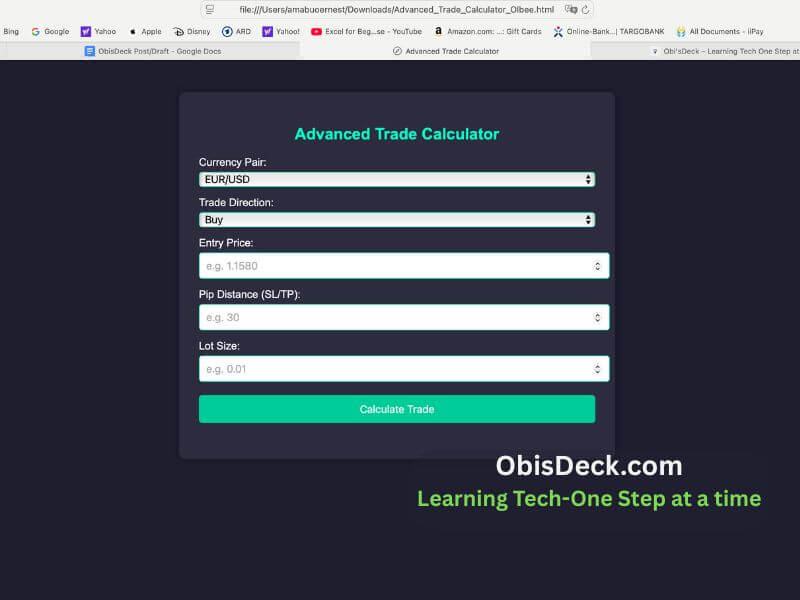
So, over the past few weeks, I’ve been diving into trading using MetaTrader 5 and setting up a proper trading journal. I also began building simple tools — like a pip calculator — and practicing with a demo account through Admiral Markets.


Why I Decided to Learn Trading

Information about trading has always been around me. I’m not talking about the get-rich-quick ads on Facebook or Instagram that push you toward buying strategies or courses. I’m talking about real trading insights: strategies, deeper understanding, the risks and the potential gains.

Conversations with a few people, as I mentioned, helped set me on this path. But the final spark was the possibility of taking structured steps and learning by building pip calculators, trading journals, and tools — all leaning toward automation, which is part of my broader IT learning journey.

This is also part of my pursuit of new ways to generate income. I wanted something that:
✅ Is flexible (I can trade even with a full-time job)
✅ Can be scaled over time
✅ Gives me full control — no one manages my money but me

Trading matched these goals — but I knew it also came with risks. That’s why I committed to learning first, not rushing.


Lessons From My First Trading Weeks

A Trading Journal Is Essential

Keeping records of each trade (what I saw, why I entered, what happened) helps me learn much faster than just guessing or jumping in blind.

I used to think trading involved everything but skill. Now I know that “luck is the intersection between preparation and opportunity.” You must learn the “waltz and foxtrot” of it all. Commit to a deeper learning of the process and extricate yourself from emotions that come with it while focusing on technical and fundamentals of the entire exercise.

Understanding Risk-Reward

Using a clear R:R (Risk-to-Reward) ratio for every trade helps me protect my account and avoid emotional trading.


Building Tools Helps Learning

Creating my own pip calculator in JavaScript has taught me more about pip size, SL/TP, and pair differences than any YouTube video could.

While I don’t underestimate the importance of good YouTube videos on trading, one should be able to localize what is learned — by taking from them and building tools that work for you.


What I’m Working On Next

✅ Testing small demo trades using my tools
✅ Learning more about using technical indicators (RSI, Moving Averages)
✅ Improving my Google Sheet trading dashboard
✅ Exploring automation possibilities (APIs, Zapier)
✅ Continuing to journal every step — wins and mistakes


Final Thoughts: Trading Is a Journey, Not a Race

If you’re new to trading like me, here’s my advice:

Don’t try to “beat the market” overnight.
Start with learning, take notes, build your tools, and track your progress.

This is exactly what I’m doing — and I will continue to share both my wins and mistakes as I go.

Stay tuned for more — and if you’re on a similar learning path, let’s connect!

HTML Basics: The First Building Block of the Web

What I’ve Learned So Far About the Web’s Foundation

I will never forget how my love for literature opened the doors to the world of tech. From Shakespeare to Chimamanda Ngozi Adichie (my second daughter’s namesake), I was always drawn to how words shape meaning. Back then, everything I read followed the same form — paragraphs, punctuation, printed language.

But today, the internet has become the new library, the global stage, the printing press of our age. It holds books, news, images, videos, and even live broadcasts — all formatted and structured not just by language, but by code.At first, I thought writing online followed the same rules as traditional writing. I was wrong. The internet has its own structure, and its name is HTML — a powerful, silent language that gives order and shape to the web.

What Is HTML, Really?

HTML stands for HyperText Markup Language.It’s the skeleton of every website you see — organizing content, defining where things appear, and making sure the browser knows how to display them. HTML does not  make websites look beautiful (that’s CSS), or make them respond to actions (that’s JavaScript), but without it, there would be no structure at all.

My First Few Tags

I started with just a few basic tags:

<html>, <head>, <body>, <p>, <h1>

At first, they looked strange. But once I practiced wrapping my words inside them, I began to see the pattern. <h1> gave me headlines. <p> wrapped my thoughts into neat paragraphs. <body> told the browser, “Here’s the main content.” Suddenly, I wasn’t just writing — I was building.

Mistakes I Made as a Beginner

Like any beginner, I stumbled:

To have order, there must be rules.

  • I forgot to close tags (</p>, </body>) and watched my whole page collapse
  • I confused class and id between HTML and CSS
  • I sometimes put CSS rules directly inside HTML, not knowing how to link stylesheets

But each mistake taught me something.

What’s Next?

Now that I understand the basics, I am excited to:

  • Combine HTML with CSS for layout and design
  • Create simple templates I can reuse
  • Practice building pages from scratch using VS Code

Final Thoughts

If you are new to coding, look here but here’s my advice:

Start small. Test often. Don’t be afraid to break things.

With every tag you write, you will understand more about how the web works — and the satisfaction that comes from seeing your ideas take shape is unlike anything else.

Feel free to share your first steps in coding, or drop any questions below. Let’s learn together — one tag at a time.

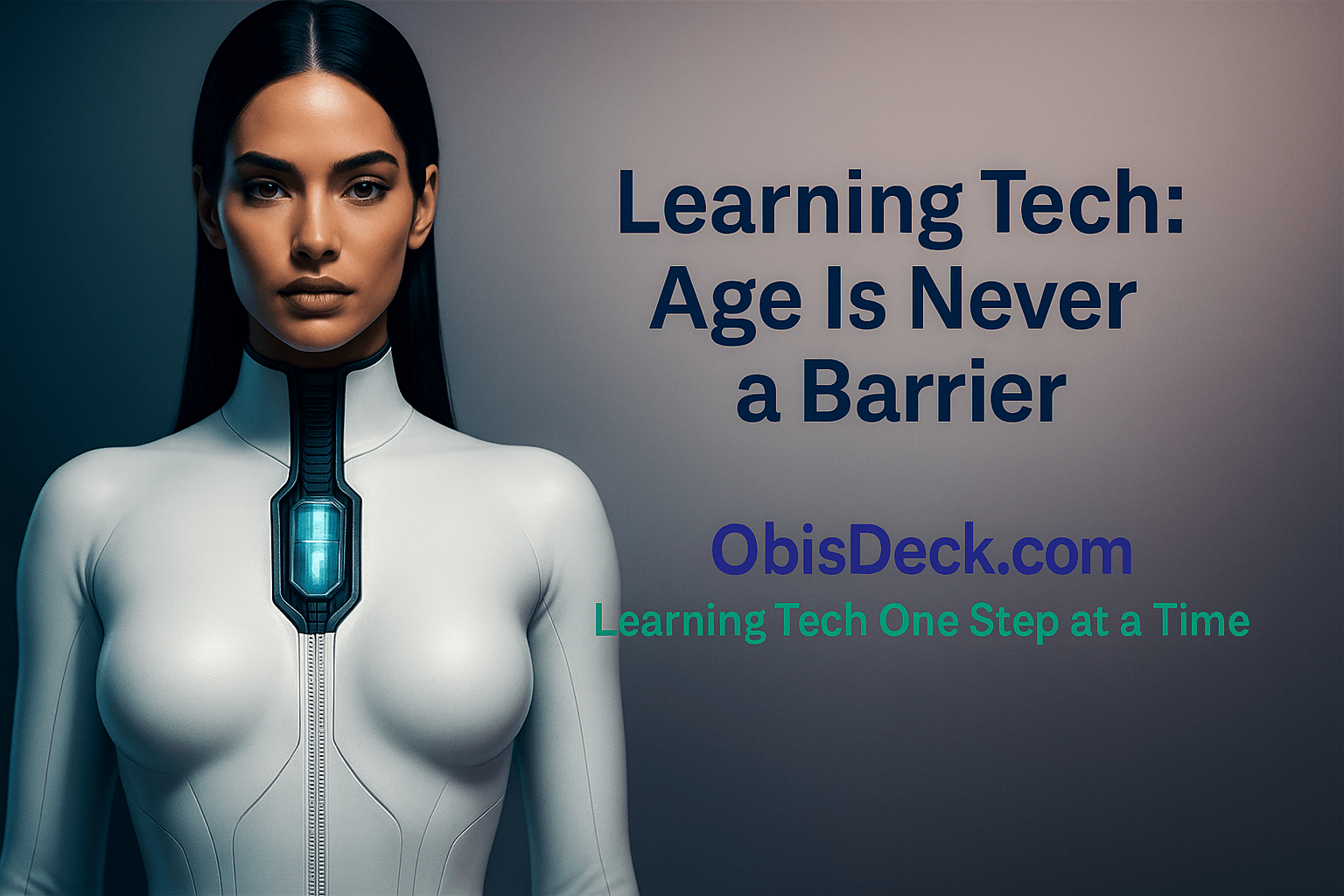
Learning Tech: Age Is Never a Barrier — What I’ve Discovered About Growth and Change

Introduction

If someone had told me years ago that I’d be editing websites and learning bits of code in my 50s, I would have smiled politely and changed the subject. Technology, to me, was always something other people mastered — the young, the mathematically gifted, the naturally curious. But here I am, navigating my way through HTML, CSS, and digital tools I once thought were far beyond my reach.

And I’m not just surviving it — I’m growing through it.


a middle aged man sitting on a desk with a computer
Age is never a barrier
sitting on a table articulating ideas-a way to start

The Challenge

When I first stepped into this world of tech, I will be lying if I say that I was not overwhelmed. The language was unfamiliar, the tools were many, and the learning curve felt steep. There were moments I stared at the screen, unsure where to click next. I worried I was too old, too slow, or too late to catch up.

Worse still, old fears resurfaced. The same fear that once made me avoid learning table tennis as a child — the fear of making mistakes and being laughed at — showed up again. Only this time, it came dressed in digital clothing.


The Turning Point

What changed?

It wasn’t a sudden burst of courage or brilliance. It was a quiet decision: I would no longer let fear be my guide.
I had a message to share, a voice to express, and technology had become the path to make that happen. I didn’t need to become a programmer. I just needed to be willing to learn — one step at a time.

And once I gave myself permission to be a beginner, something incredible happened: I started enjoying it. The tools that once scared me began to make sense. With each small win — adding a line of code, publishing a blog post, resizing an image — I felt more alive.


What I’ve Learned

This journey has taught me far more than just a few technical skills. It’s taught me about patience, humility, and the beauty of lifelong learning. I’ve learned that age doesn’t disqualify you from growth — it equips you with the maturity to appreciate it.

Learning tech didn’t just stretch my mind — it expanded my confidence. I began to see that my story, told through a digital lens, could reach people I may never meet in person. That’s a powerful thing.

A Personal Realization: Learning Has No Age Limit

I agree that learning follows some general principles. I’m not here to reinvent those or push new boundaries. But I am entitled to tell my own story—and that, I will do, in the only way I can.

Yes, learning has structure, but it is also a journey. And like any journey, it is shaped by the one walking the path. No two experiences are exactly the same.

I have never enjoyed learning more than I do now. Perhaps it’s a function of age. My experience isn’t fundamentally different—but there are things you only fully understand when you’ve lived a while. This, for me, is one of them.
Now feels like the perfect time to learn. The exuberance of youth has given way to something clearer. My mind feels focused. Tasks I once found scattered now appear like vivid pictures—drawing from things I’ve seen, read, lived, and learned over the years. It all comes together in ways that feel whole and fulfilling. Learning is no longer a struggle. It’s a joy. A privilege.

Just yesterday, during a session with ChatGPT about coding basics, fragments of my learning journey came alive—triggered by its clear prompts and structured guidance. A few years ago, this wouldn’t have resonated the same way.

This kind of experience is unique. Personal.

So, why not try something new today?

Olbee- Learning Tech-one step at a time


You might just uncover your self-worth—or awaken a hidden talent you didn’t know you had.
There’s a learning path out there that only you can walk.


Encouragement to Others

If you have ever felt like it’s too late to learn something new, especially something like technology, let me be honest with you: it’s not too late.

You don’t have to master everything. You just have to start.

You might stumble, yes. But every stumble is a sign that you are moving — and every movement is important because it counts.


Call to Action

What new skill would you explore if fear wasn’t holding you back? Could you share that with us?

Maybe today is the day to take the first small step.
And if this post reminded you of someone who needs a gentle nudge, send it their way. Growth isn’t a race — it’s a decision. One you can still make, right now.

Learning ChatGPT – How I Asked Questions Without Feeling Silly

Introduction

I first heard about ChatGPT from a contributor on a well-known American TV station — and that’s when I realised it was more than a passing trend. Before that, I assumed it was just another flashy tech buzzword — something meant for coders or young people fluent in digital slang.

Someone even joked that ChatGPT was just a room full of brilliant people in New Delhi, manually answering questions through a chatbot. They doubted its so-called “large language model” and believed it was all a fluke.

At the time, I couldn’t see how a tool like that could fit into my world. I was still struggling to understand how to animate text in PowerPoint or use Excel’s formulas — and here was this new thing called “AI.”

But curiosity has a way of nudging you forward. What if this tool could help me learn faster, ask questions without fear, and make my late start in tech feel a little less overwhelming?

First Impressions


When I opened ChatGPT for the first time, I was surprised by how simple it looked. No fancy ribbons like in Microsoft Excel, no stylish home tabs like PowerPoint — just a blinking cursor waiting for me to speak. I still remember my question:

How do I train as a Microsoft Administrator?

A random thought, that I found out later, unconsciously captured the direction I would be heading. To my surprise, it answered — clearly, calmly, and without a hint of jargon or judgment. It felt… human. I kept going, asking even more questions. And with each response, my hesitation gave way to confidence.

What struck me was this: I didn’t have to sound like a tech expert. I could type in half-formed thoughts, and ChatGPT would still give me something useful. It became my quiet assistant — always patient, never tired.

Has Chatbots not been around for sometime now?

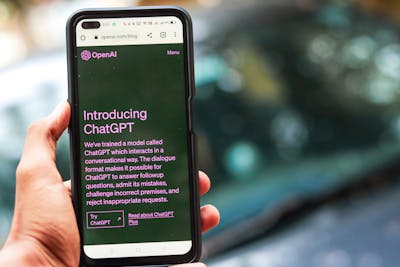
a phone displaying an introduction to ChatGPT on its screen

“Chatbots have been around for a while. Remember the little assistant on Luafthanzer’s website that helped with booking issues? Or Apple’s Siri, always ready to answer your questions?

But in 2018, something game-changing happened. A California-based tech company, OpenAI, introduced ChatGPT—a chatbot trained on a massive Large Language Model (LLM). Unlike older chatbots, it could rival human-like intelligence.Back then, I had no idea this even existed. But as I started my tech journey, I discovered how ChatGPT evolved—from just text to generating images, graphics, and more. Now, competitors like DeepSeek, Google Gemini, and others are reshaping the AI landscape even further


What I Can Do with It Now

  • Ask it to explain terms like “API”(Application Programming Interface) or “cloud storage” in plain English
  • Draft rough versions of blog posts 
  • Get unstuck when I need content ideas
  • Ask for step-by-step guidance on basic tools like Google Docs
  • Even get advice on design choices — like fonts to use on ObisDeck
  • Recently, it helped me successfully request a refund on a misleading purchase — step by step!

Tips for Beginners Like Me

  • You don’t need to be a “prompt engineer.” Just start typing.
  • Be clear and simple. For example:
    “How do I create a folder in Google Drive?”
    is better than
    “Google Drive tips.”
  • Ask everyday questions like:
    • “What image sizes work best for Facebook, Instagram, and LinkedIn?”
    • “How do I get started in Canva?”
    • “My internet is connected but not browsing — what should I check?”
  • If the answer feels too complex, just ask:
    “Can you explain that in simpler terms?”

How I Plan to Use It

ChatGPT has become part of my daily routine. I use it to:

  • Draft outlines for future blog posts
  • Generate image prompts for Canva and Midjourney
  • Clarify concepts before teaching them to others
  • Schedule or brainstorm blog content
  • Stay motivated in this lifelong learning journey

Closing Thoughts

Learning ChatGPT didn’t require programming skills — just curiosity and a willingness to try. It’s helped me feel less alone in this digital world, and more capable, one question at a time.

If you’re new to AI tools or even just tech-curious, try asking ChatGPT that question you’ve always been afraid to ask out loud.

You might be surprised how helpful it is.

Have you tried ChatGPT yet? What was your first question?

What Tech tool have you tried?, Please, share your experience with us today in the comment section below. We would like to learn from you too.


From Fear to Flow: My Journey into Tech, Storytelling, and Solar Energy

Editor’s note:
This post marks the beginning of a learning journey I’m now documenting in full. If you would like to see how this story unfolds — from foundations to confusion to clarity — you can explore the full journey here:
→ My Tech Learning Journey — One Step at a Time

How a lifelong love of words led me to confront my fears, embrace technology, and find a new voice in a changing world.


For Me, IT Was a Myth

IT always felt like a myth — something buried deep inside the mathematics I struggled with as a child. Early on, I fell in love with literature instead. The way Shakespeare wove his words in prose and fiction always caught my fancy. Whenever I held one of his books, nothing else seemed to matter.

I dreamed of telling my own stories one day — through prose and fiction too. But the world has evolved far beyond printed words. In our quest for progress, we’ve created tools so powerful that even the best stories can now be written, read, and shared on devices that offer speed and convenience.


The World Has Changed — And So Must I

Technology — especially the internet — has transformed our lives in more ways than one. And if I truly want to tell my stories in today’s world, I have to learn new skills. I had no choice. I had to confront my old fears.

Up until recently, my only tech skills were checking emails and doing simple web searches. Now, I can find information faster than I ever could in a physical library. I began to ask: How are the words on web pages written?

To my surprise, a basic computer course I took back in university — which once felt meaningless — began to make sense. Terms like HTML, CSS, JavaScript, and Python no longer frightened me. In fact, they intrigued me. I had discovered a better way not only to tell my stories, but to share them with the world — in just a few clicks.


My Tent in Solar, and the Spark It Lit

When I decided to pitch my tent in the world of solar energy, I discovered how exciting and empowering these tech skills could be. What began as a search for basic training became the spark that rekindled something deeper: a belief that I still had much to learn — and even more to give.

But along the way, doubts crept in.


A Memory, a Mistake — and a New Resolve

Did I come to this too late?
At my age, does it even matter?

Then I remembered something from my childhood. I never learned to play table tennis. Every time we gathered to play, I was afraid my mates would laugh at my mistakes. So I stood back. I watched. I stayed safe.
And because of that fear, I never practiced — and never got good.

Now, I see it clearly: I didn’t fail because I lacked ability. I failed because I let fear decide for me.

Today, I choose differently.

I won’t let the fear of mistakes or the judgment of others stop me from showing up or trying something new. I may be late to the tech world, but I’m here now. And every step I take is a quiet rebellion against the voice that once told me I couldn’t.


Everyone Has a Story

Everyone has a story. You can only tell yours — and tell it the best way you can.
All stories are peculiar, in different ways.
Yours might begin in the forgotten jungles of the earth, or in the bustling cities of modern America.
Mine? It’s still being written — one brave sentence at a time.

If you have read this far, thank you. Let us hear from you on how we can make this journey as interesting as ever can be.